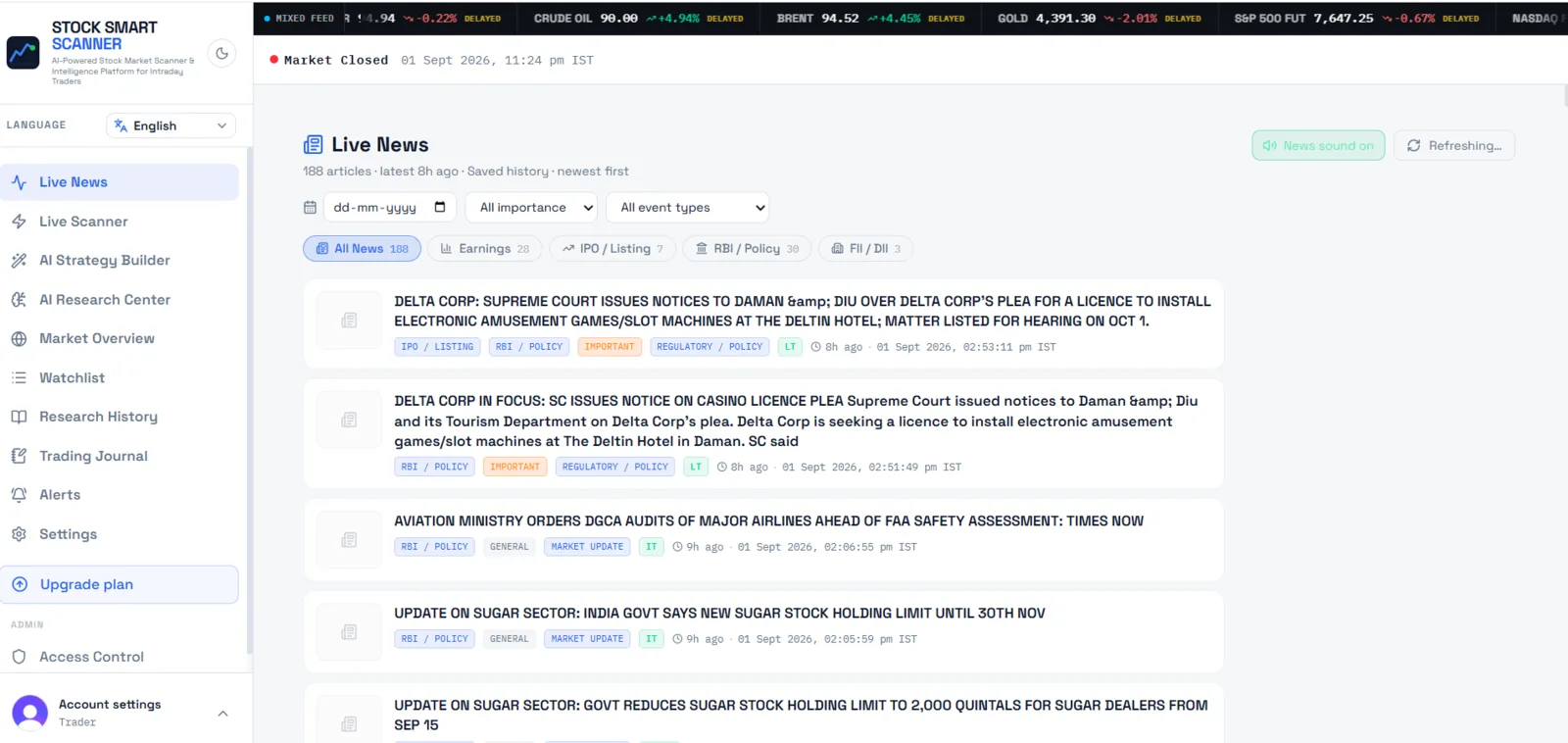
Why market news matters to intraday research
Price and volume show what the market is doing; news can help explain why a move may be happening. An earnings update, exchange filing, policy announcement, order win, management comment, rating change, or sector event can alter the questions a trader asks about a stock. The timing matters because a headline published after a move may explain the reaction without being the original cause, while a headline published before the move may already be reflected in price.
A live news workspace does not need to promise that it has every headline to be useful. It should make available items easier to find, sort, and compare. Stock Smart Scanner presents news as research context, not as a buy or sell signal. The responsible reader checks the publication time, source, exact claim, and whether an official document contains more detail than the headline.
Read the source and timestamp before the headline
A headline is a compressed summary. Before relying on it, identify who published it, when it was published, which company or sector it concerns, and whether it points to a primary document. Official exchange filings, issuer investor-relations pages, regulator releases, and company results generally deserve more weight for material facts than a short secondary description. A timestamp tells you whether the market had time to react before you saw the item.
News can be updated, corrected, syndicated, or repeated across several outlets. Several copies of the same story do not necessarily represent several independent confirmations. Record the original source when possible and compare the wording with the underlying document. If an item is unavailable, delayed, or partially described, label that limitation rather than inferring that no related news exists.
Separate event categories before interpreting price
Different event types create different research questions. Results and guidance require attention to reported numbers and comparisons. Corporate actions require attention to record dates, ratios, approvals, and eligibility. Orders and partnerships require attention to value, duration, execution conditions, and whether the disclosure is binding. Regulatory or policy news may affect an entire sector rather than one company. A generic positive or negative label hides these differences.
Use the category to decide what to verify next. If the story concerns an order, look for the official filing and materiality details. If it concerns results, compare the announcement with the company’s investor-relations release. If it concerns a sector rule, check the regulator or ministry source. The point of categorization is not to predict an outcome; it is to keep the research question specific enough to answer.
Connect news with price, volume, and sector context
Once an event is verified, compare its time with the stock chart and volume. Did the move begin before the news? Did price react and then reverse? Did peers move in the same direction? Was the headline released during a broad market move? These questions help separate company-specific information from a general risk-on or risk-off session. They also prevent a reader from assigning causality to the most recent headline simply because it is easy to see.
A positive headline can already be expected, incomplete, or offset by a weaker detail. A negative headline can produce a brief reaction and then fail to change the larger trend. Use the Live Scanner, Market Overview, and a watchlist as separate research steps rather than forcing every news item into a trade idea. The strongest conclusion may be that the event deserves monitoring, not immediate action.
A reliable live news workflow
Begin with the company, sector, or market topic you are studying. Filter the available feed, then shortlist items with a clear timestamp and an identifiable source. Open the original release, write down the exact material claim, and compare it with the latest price, volume, index, and sector context. If the event is old or already widely reflected, record that as part of the interpretation.
Keep a distinction between reported fact, market reaction, and your own hypothesis. For example: the company disclosed a contract at a stated time; the stock traded above a level after the disclosure; the next question is whether the contract is financially material. That structure is more defensible than writing that the headline caused a guaranteed rise. It also makes later review easier when the price response changes.
Why missing news is not proof of no news
No result in a feed can mean that there was no matching item in the available coverage, that the provider has not refreshed, that the wording did not match the filter, or that the relevant information is published elsewhere. It does not prove that the company has no news. This is especially important during fast markets, outside regular hours, and when a source publishes through an exchange or issuer channel that is not represented in the same feed.
Treat coverage as a measured capability with limits. When an event matters, use the exchange, company, regulator, or other primary source directly. Stock Smart Scanner can help organize available market information, but it cannot replace the source that owns the disclosure. Clear uncertainty is better than an invented summary or a false impression of complete coverage.
Use Live News as context, not a recommendation
News can improve a research checklist, but it cannot decide whether a trade is suitable. Consider liquidity, spread, risk, position size, market hours, and the possibility that the market reaction is already complete. Do not trade solely because a headline sounds positive, and do not short solely because a headline sounds negative. The same event can affect different companies differently depending on expectations and valuation.
The safest use of a live news tool is to make the next verification step obvious. Identify the source, understand the event, compare the reaction, and record what remains uncertain. That process supports independent analysis while keeping the boundary clear: the platform is informational research, not personalized investment advice or a promise of a market outcome.
Continue your research
- Live ScannerCompare news timing with technical screening results.
- Stock Market Overview and Sector HeatmapCheck broader index and sector context.
- How to verify market newsRead the public verification guide.
Authoritative references
Use primary exchange and regulator sources to verify material claims.
- NSE corporate filings and announcementsCheck exchange-published disclosures.
- SEBI InvestorReview official investor education and disclosure guidance.