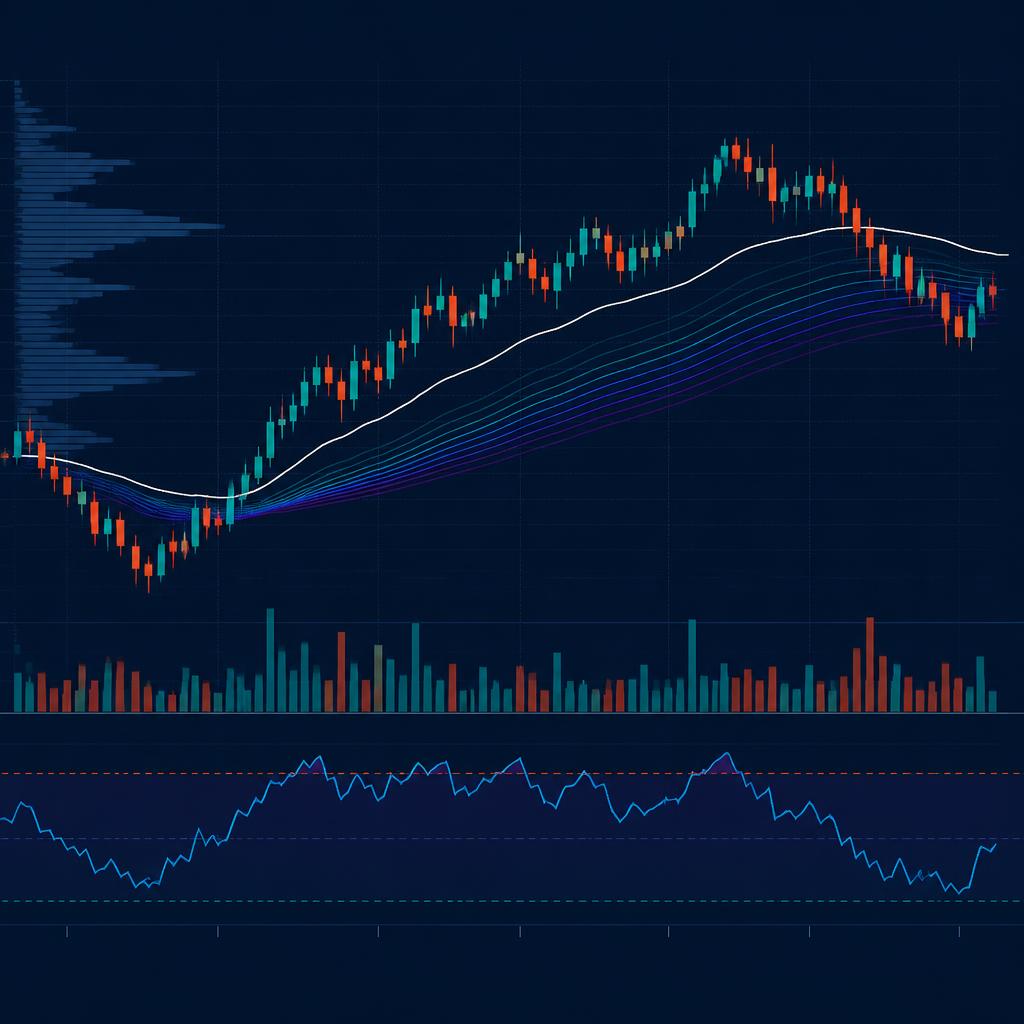
Start with a precise setup definition
An intraday setup should describe what must be true before it deserves review. Instead of saying that a stock looks strong, define the conditions: price is above a chosen moving average, a completed candle has reclaimed a level, volume is above a stated baseline, and the broader market is not contradicting the move. A precise definition makes the idea testable and reduces the temptation to change the rules after seeing the chart.
The definition should also state the timeframe. A five-minute breakout, a fifteen-minute trend continuation, and a one-hour level answer different questions. Mixing them without labeling the timeframe can make a setup appear stronger than it is. Stock Smart Scanner helps organize these questions and show available evidence, not turn a label into a guaranteed entry.
Use completed candles instead of intrabar guesses
A candle that is still forming can cross a level, create a long wick, or show temporary volume that disappears by the close. Confirmation based on an unfinished candle is fragile. When reviewing an intraday setup, note the close time, timeframe, price relative to the level, and whether the candle was complete when the condition was evaluated. This is especially important around market open, news releases, and volatile breakouts.
Completed-candle logic does not make a setup certain. It makes the observation reproducible. Another researcher can check the same bar and understand what the platform knew at that time. If the required candle history is unavailable or delayed, the correct result is an evidence gap. Do not fill that gap with a synthetic match or present a missing timeframe as confirmation.
Combine VWAP, EMA, and price structure
VWAP and EMA describe different relationships. VWAP estimates the session’s average traded price weighted by volume, while an EMA gives more weight to recent prices. A price holding above both can support a momentum research question, but it does not tell you whether the move is extended or approaching resistance. A price below both can flag weakness, but it may also be near a level where sellers lose control.
Use indicators with visible price structure. Mark the prior swing, range boundary, nearest support and resistance, and the point where the interpretation would be wrong. If price crosses an average but cannot hold the level on a completed candle, record that failed confirmation. Indicators are most useful when they describe a sequence of price behavior rather than when they are counted as independent votes.
Treat support and resistance as zones
Support and resistance are areas where prior participation may influence the next decision, not exact lines that must reverse price. Use completed fifteen-minute and one-hour context when the setup depends on a meaningful intraday level. Record how the level was formed, how many times it has been tested, and whether the current move approaches it with expanding or fading participation.
A breakout through resistance needs more than a momentary wick. Review the closing price, follow-through, volume, retest behavior, and whether the broader index or sector supports the move. A breakdown through support requires the same discipline. If the level is too close to the planned risk boundary or the next opposing zone, the setup may be interesting but not practical for further study.
Add index, sector, and news context
A stock-level setup is easier to interpret when its environment is visible. Compare the relevant index direction, sector breadth, peer behavior, and the timing of any company or policy news. A bullish pattern inside a weak sector may be a relative-strength question; a bearish pattern during a broad market selloff may need a different interpretation. Context does not override setup rules, but it can expose when the setup is driven by a wider move.
Use context to ask what would invalidate the explanation. If the move is said to be company-specific, are peers behaving differently? If it is said to be sector-led, is participation broad? If the setup depends on news, has the primary source been checked? This keeps context analytical instead of turning correlated indicators into false certainty.
Define confirmation and invalidation before acting
Confirmation is the evidence that makes the setup worth continuing to study. It can include a completed close beyond a level, a retest that holds, volume that remains meaningful, or a market condition that agrees with the hypothesis. Invalidation is the evidence that the hypothesis no longer describes the chart: a failed reclaim, a close back into the range, a broken support, or a required data field that cannot be verified.
Writing both in advance reduces hindsight and prevents moving the goalposts when price behaves differently. The platform can show what matched and what did not, while the user remains responsible for deciding whether the idea is suitable. No amount of confirmation removes gap risk, execution risk, slippage, liquidity risk, or the possibility that the underlying data is incomplete.
A repeatable intraday setup checklist
Before the session, define the symbol universe, timeframe, indicators, market conditions, and maximum number of research candidates. During the session, wait for the relevant candle to complete, record the timestamp, and compare the setup with VWAP, EMA, volume, support, resistance, index, sector, and news context. Shortlist only setups whose evidence is visible and whose explanation is specific.
After the session, compare the original note with what happened next without rewriting the original conditions. Did confirmation hold? Did market context change? Was invalidation clear? Did the setup fail because the rule was poor, the data was incomplete, or the market behaved differently? This review improves research without converting a historical observation into a performance promise.
Research first, decide independently
Intraday analysis is uncertain by design. A setup is a structured hypothesis about price behavior, not an instruction. Stock Smart Scanner does not provide personalized buy, sell, or hold recommendations, and it does not guarantee an outcome. Verify important facts with exchange, issuer, broker, regulator, and other primary sources before relying on them.
The best result of setup research is often a clearer question: what evidence is present, what is missing, and what would make the interpretation wrong? That clarity is more durable than a confident label. Use the public guide to understand the method, then use the private workspace only for your own authenticated research records.
Continue your research
- Live ScannerStart with measurable candidates.
- Trading JournalRecord setup evidence and review the process.
- Intraday trading strategiesExplore the public strategy research collection.
Authoritative references
Use primary exchange and regulator sources to verify material claims.
- NSE India market dataCross-check exchange market information.
- SEBI InvestorRead official investor education material.